The Salvation Army
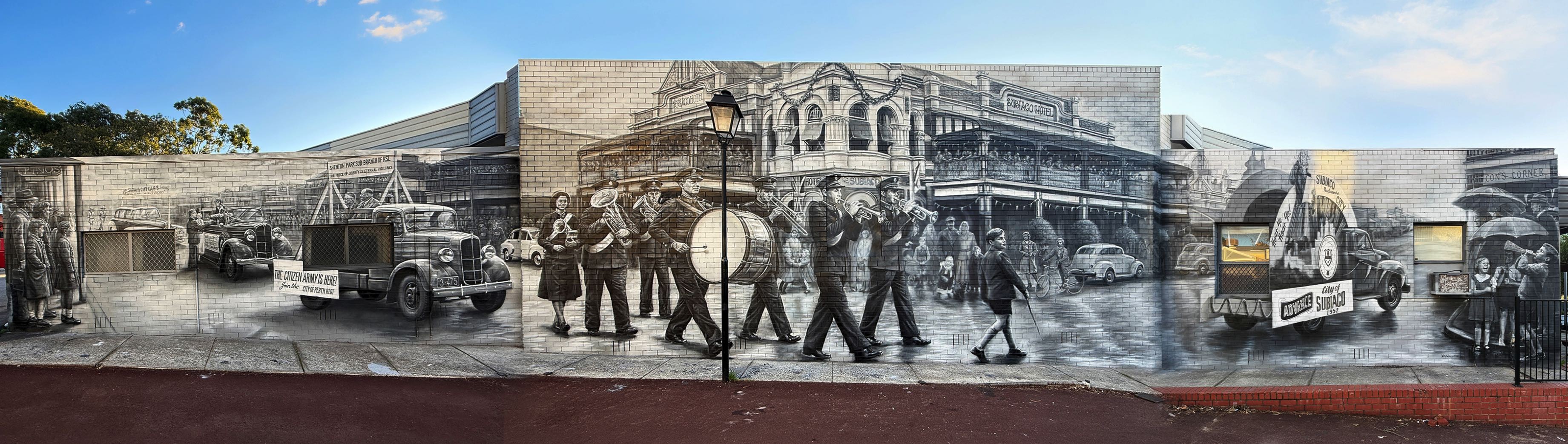
The band connects the historical photographs with The Third Place today. It also carries the mural’s central idea of finding belonging and helping others move forward.
SUBIACO, WESTERN AUSTRALIA · PAINTED 2026
A street full of history.
A community still adding to the story.
01 / THE BEGINNING
This mural began with old photographs of a city celebrating itself.
When the City of Subiaco approached me about the wall at The Third Place, the 1952 celebrations offered a starting point. Looking through the archival photographs, I was drawn to the people gathered along the streets, the band and the shopfronts behind them. There was a whole scene to explore.
The Salvation Army photograph became the heart of the design. That connection mattered here: The Third Place continues the Salvation Army’s presence at this address, so the history in the painting is tied to the building it lives on.
I wanted to bring those separate moments together so you could stand in the laneway and feel part of the street. The finished mural stretches about 27.5 metres, giving the people and their stories room to unfold.
— Jacob Butler, Shakey
THE STORY WITHIN THE SCENE
At the front of the imagined procession is a boy who has found a sense of belonging through the Salvation Army.
His story is symbolic. He represents people who have come through difficult circumstances and found home, family and purpose through the organisation. As he steps forward, the children and spectators around him look on.
For me, that is the idea behind the title: someone who finds their own footing can give others the confidence to move forward too. It sits alongside Subiaco’s own story of community and identity.
02 / THE RESEARCH
My research brought together historical writing, archival images and conversations about Subiaco. Ken Spillman’s Identity Prized: A History of Subiaco (1985) was one of the written references behind the project. The Subiaco Museum photographs available through Collections WA supplied the visual starting points.
The 1952 photographs let me study details that are easy to miss at first: how the band stood, the people watching, the buildings behind them and the way a crowd occupied the street. Those details helped turn a broad historical theme into a scene with individual character.
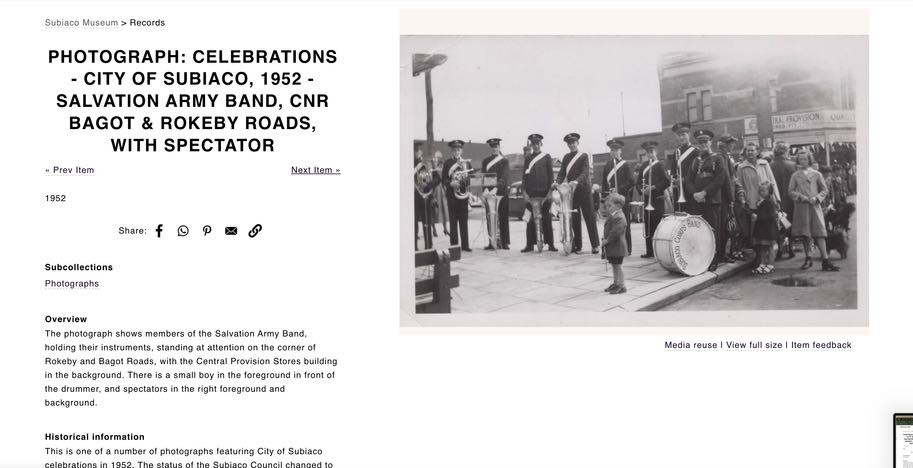
In the principal reference photograph, the Salvation Army band is assembled at the corner of Bagot and Rokeby Roads. The musicians are standing at attention, with the Central Provision Stores behind them and a small boy near the drummer.
I reimagined that gathering as a procession. This gave the composition movement and allowed the band, spectators, buildings and floats to flow across the wall.
Explore the original archive record ↗03 / REBUILDING THE STREET
The street behind the people needed just as much consideration as the procession itself.
The composition combines material from different photographs. The band, crowd and architecture had to work together at the scale of the wall, with a consistent sense of space. Recreating the scene meant making decisions about viewpoints, figure sizes and how one reference would connect with the next.
The hotel became a key historical anchor in the design. Rebuilding its place in the street from old photographs helped make the setting recognisably Subiaco. Its façade and the surrounding shopfronts give the procession a particular place to move through.
Historical images preserve details that can be difficult to read in the present-day street. A circa-1950 view in the Subiaco Museum collection shows Hay Street looking west towards Rokeby Road, with the hotel’s spire, tram lines and vehicles. It offers a useful view of the setting around the period represented in the mural.
See Hay Street around 1950 ↗During the design development, I corrected the parade direction to come down Hay Street, turn the corner and continue up Rokeby Road. That changed how the scene needed to fit together, with the hotel helping establish the corner.
A composition on a screen still has to work on a building. During installation, I adjusted the design around the wall’s proportions, windows and other interruptions. Viewing angles, the placement of people and their scale all needed attention so the separate parts read as one continuous scene.
04 / THE PEOPLE
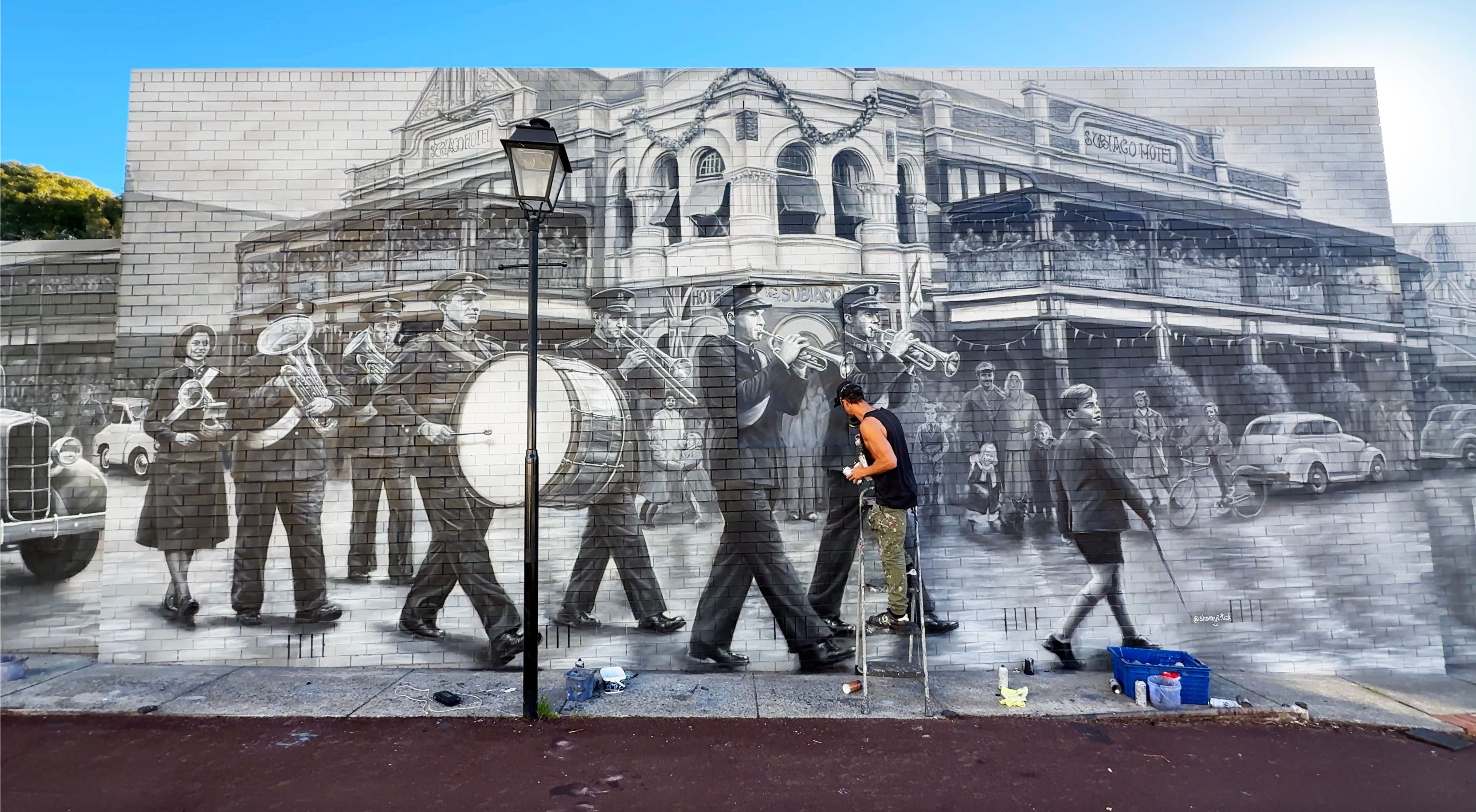
As the mural developed, the crowd became a way to recognise people with connections to Subiaco and the wider community.
Some belong to the history of the period; others invite us to think about what the children of that generation would go on to do. Their inclusion gives the painting stories to discover beyond the first view of the parade.
The band connects the historical photographs with The Third Place today. It also carries the mural’s central idea of finding belonging and helping others move forward.
Look for Potts watching over the RSL float. His inclusion brings military service and remembrance into the wider community scene.
Peter is one of the people recognised in the mural. The connection continued beyond the painting when his daughter Eddie shared a video of him seeing his portrait—a personal response to a story now on a public wall.
Rose is among the named individuals woven into the composition. Recognising people individually is part of what turns this crowd into a collection of local stories.
Shown beside a cot, Matron Walsh brings King Edward Memorial Hospital into the story. Her inclusion grew out of a conversation during the final stages of painting.
The Olympic athlete appears in a greeting with the mayor of the time, bringing sporting achievement into the mural’s celebration of community life.
05 / ON THE WALL
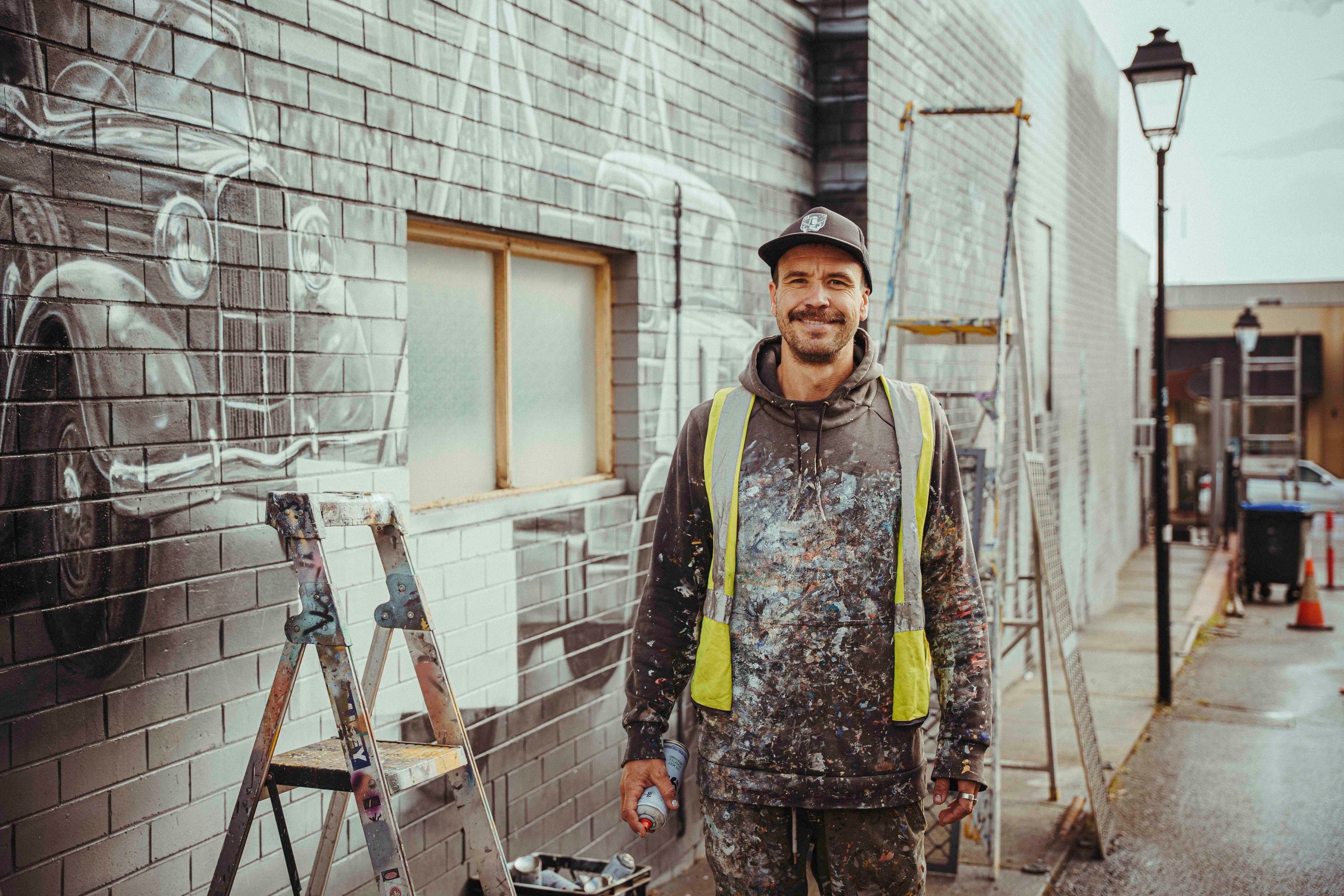
Working in the laneway meant people could stop for a look and a chat. Some came back regularly. They shared memories, recognised details and suggested people with connections to the area. The staff at The Third Place were generous with their support throughout.
Those conversations added something the photographs alone couldn’t provide: the experience of people who knew the place and cared about its history.
Towards the end of the project, I met Professor John Newnham AM. Our conversation led to the addition of Matron Agnes Marion McLean Walsh beside a cot, bringing the history of King Edward Memorial Hospital and its work with mothers and babies into the mural.
John later referred to the mural in his speech for the hospital’s 110-year celebrations. He also knew Peter Nattrass—another connection between people whose stories had found their way into the painting.
I developed the research and design and painted the mural with Joseph Boin, Art by Destroy, as second artist. The wall was cleaned and primed, then built up in greyscale, with aerosol used for the detailed artwork and portraits.
From a distance, the figures and architecture need to hold together. Up close, you can see the individual faces and the brick surface underneath. Both are part of experiencing the work in person.
06 / FOLLOW THE REFERENCES
Explore the original photographic records and the book behind the research.
Commissioned by the City of Subiaco.
Artwork by Jacob Butler (Shakey), with Joseph Boin (Art by Destroy) as second artist.
Archival photographic references: Subiaco Museum, through Collections WA.
With thanks to The Third Place and the people who shared their time, memories and connections.
Mural and installation photographs reproduced from the artist’s project documentation. Archival reference credited to Subiaco Museum.